

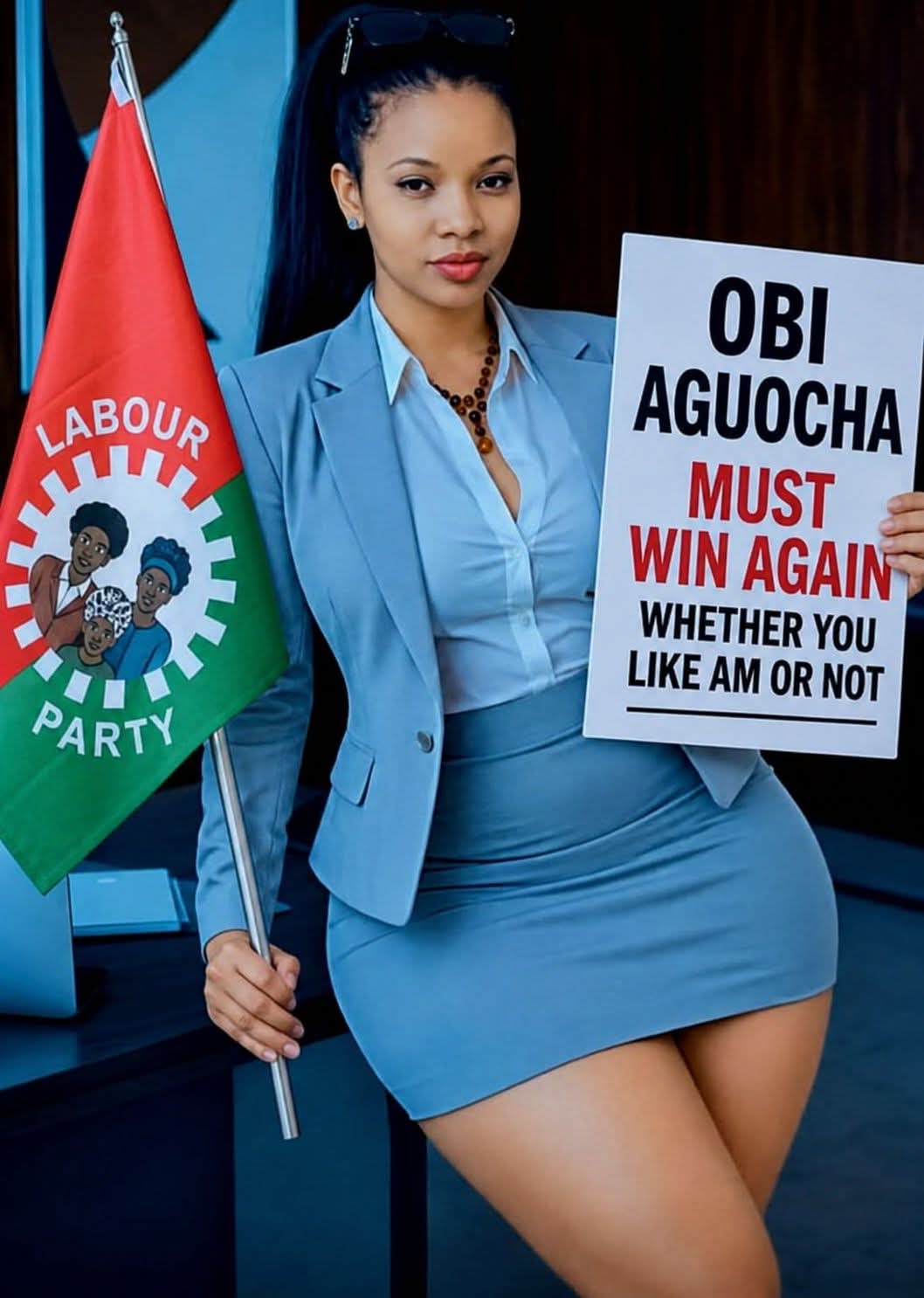
The image may be attention-grabbing, but it also raises uncomfortable questions that no serious constituent should ignore.
If this is what is being presented, even loosely, as the constituency project delivered by Obi Aguocha to the people of Ikwuano, Umuahia North, and Umuahia South Federal Constituency, then we are dealing with a troubling example of politics replacing substance with spectacle. The photograph does not answer the central question people are asking; it only sharpens it.
At first glance, the visual is polished and deliberate.
The Labour Party flag is held with confidence, the pose is calculated, and the placard is designed to command attention. But all of that is presentation, not proof. In a political environment where citizens are constantly told to celebrate loyalty and applaud branding, it is worth pausing to ask what exactly has been delivered to the people beyond the image itself.
This is where the criticism becomes unavoidable. Too often in our politics, public office holders and their promoters rely on optics to create the impression of action. They package enthusiasm as achievement and style as service. Yet constituents do not live on slogans. They live on roads that either exist or do not exist, on schools that either function or fail, on health facilities that either serve them or leave them stranded, and on empowerment programmes that either reach them or remain empty promises.
If the photograph is being used to suggest that the lady in it represents the constituency project delivered by Obi Aguocha, then the argument collapses under its own weight.
A constituency project should be visible, tangible, and verifiable. It should not require rhetorical gymnastics or political interpretation before people can understand what has been done. Once citizens must be asked to decode a photograph in order to find evidence of delivery, the political message has already become suspect.
That is why the image deserves a critical reading rather than a celebratory one.
It reflects a broader political culture in which appearance is often mistaken for achievement. Supporters are encouraged to focus on loyalty, emotional attachment, and party identity, while the question of actual performance is quietly pushed to the side. But a serious democracy cannot survive on sentiment alone. Representation is not a fashion statement, and public office is not a stage for visual theatrics.
For the people of Ikwuano, Umuahia North, and Umuahia South, the standard should remain simple and uncompromising: what has been done, where has it been done, and how has it improved their lives?
If there is a project, let it be shown plainly. If there are interventions, let them be identified clearly. If public funds have been spent, let the result be visible enough to stand on its own without exaggeration, spin, or staged symbolism. Anything less amounts to political packaging.
The deeper issue here is not just Obi Aguocha, but the unfortunate habit of some political actors to confuse visibility with value. A loud slogan does not equal service.
A carefully managed image does not equal impact. And a provocative photograph does not erase the demand for results. In fact, when the gap between the image and the reality is too wide, the photograph becomes evidence not of delivery but of desperation.
This is why serious criticism matters. It is not enough for politicians to be seen; they must be held accountable for what they have actually done.
If constituents are left with no clear project to point to, then no amount of public relations should be allowed to rewrite that reality. The job of a representative is not to manufacture applause, but to produce results that can withstand scrutiny.
Obi Aguocha should be judged by the record he leaves behind, not by the strength of the branding around him.
If there is a constituency project, it should be obvious enough that nobody needs persuasion to recognize it. If there is no such project, then the image is simply another example of how politics can attempt to dress absence in the costume of accomplishment. For a serious critic, that is exactly the problem.
In the end, the people of the constituency deserve honesty, not optics. They deserve delivery, not decoration.
They deserve representation that can be measured in real terms, not political theatre wrapped in a polished photograph. And if this image is meant to stand in for performance, then it only proves how far some politicians are willing to go to make packaging look like progress.
Stay informed and ahead of the curve! Follow The National Concord Blog Newsletter for real-time updates, breaking news, and exclusive content. Don't miss a headline – join now below!