

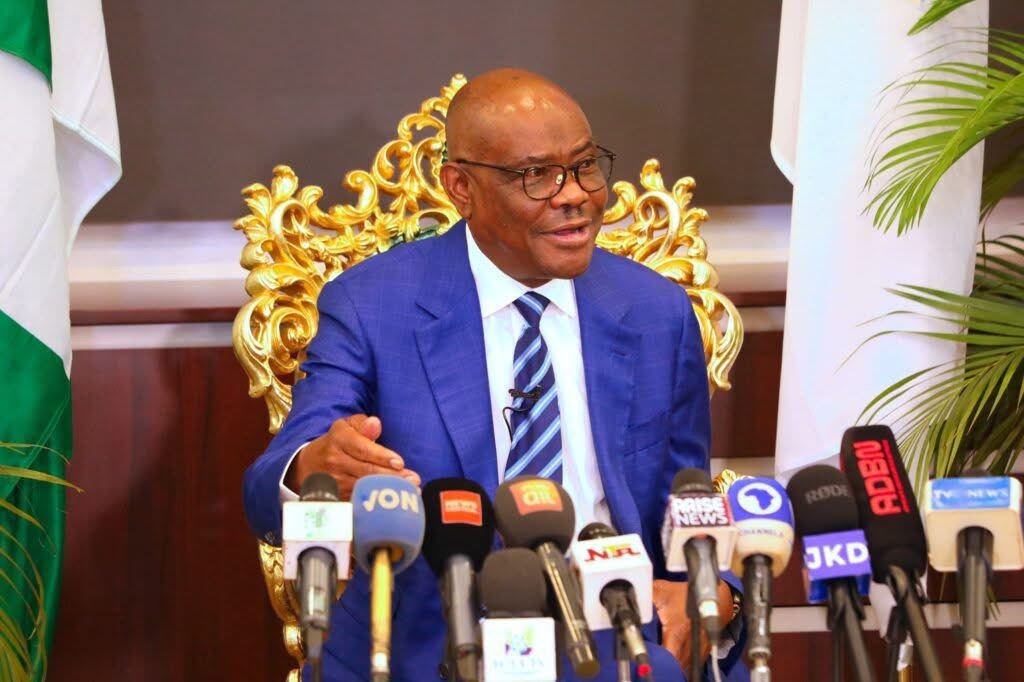
The Minister of the Federal Capital Territory, Nyesom Wike, has publicly declared support for President Bola Ahmed Tinubu ahead of a potential second-term bid, reigniting national debate over the unresolved internal crisis that rocked the Peoples Democratic Party (PDP) during the 2023 general elections.
Wike’s statement has drawn renewed attention to the political divisions that weakened the opposition party at a critical electoral moment. The former Rivers State governor insisted that the PDP leadership ignored repeated warnings from key stakeholders, arguing that the party failed to address structural imbalances that triggered internal rebellion before the polls.
THE ROOT OF THE PDP CRISIS
The dispute began after former Vice President Atiku Abubakar emerged as PDP presidential candidate in 2022. Wike and allies within the influential G5 governors’ bloc demanded the resignation of then national chairman Iyorchia Ayu, insisting that both the presidential candidate and party chairman coming from northern Nigeria violated the party’s zoning arrangement.
Party leaders declined the demand, creating deep fractures that divided campaign structures nationwide. The disagreement ultimately produced parallel loyalties within the PDP, weakening coordination and fueling public perceptions of disunity.
2023 ELECTION ROLE AND POLITICAL REALIGNMENT
Throughout the 2023 campaign season, Wike distanced himself from active participation in PDP presidential rallies and avoided openly endorsing the party’s candidate. Political observers widely interpreted the move as strategic neutrality that indirectly benefited the ruling All Progressives Congress (APC) and its candidate, Tinubu, who eventually secured victory at the polls.
Although Wike never formally defected from the PDP, critics alleged that his political calculations contributed to the opposition’s electoral setbacks. His subsequent appointment as FCT minister by President Tinubu further fueled claims that his stance during the election cycle played a role in earning federal recognition — an allegation that remains politically debated.
WIKE: SUPPORT IS FOR PRO-PRESIDENT CANDIDATES
Defending his position, Wike said his political support would no longer be determined strictly by party affiliation but by alignment with the President’s policies.
“As it is today, my party seems to have not learned, and I am also going to support the President for a second term in office,” he stated.
He added that PDP leaders failed to consult him on candidates the party intended to field, despite his influence and continued membership.
“I didn’t beat around the bush when I said that as a minister, my party never asked me about the candidates they were planning to put forward, and I made it clear that I would only support candidates who backed the President,” Wike said.
According to him, such support would cut across party lines. “I never said I would support that particular party, but I did say I would support candidates who are in favor of Mr President, regardless of which party they are from,” he explained.
IMPLICATIONS FOR NIGERIA’S OPPOSITION POLITICS
Political analysts say Wike’s latest remarks underline the continuing identity crisis within the PDP, as unresolved grievances from the 2023 elections continue to reshape alliances ahead of future electoral contests. The development also signals growing cross-party political cooperation that could redefine Nigeria’s opposition landscape in the coming years.
Stay informed and ahead of the curve! Follow The National Concord Blog Newsletter for real-time updates, breaking news, and exclusive content. Don't miss a headline – join now below!