


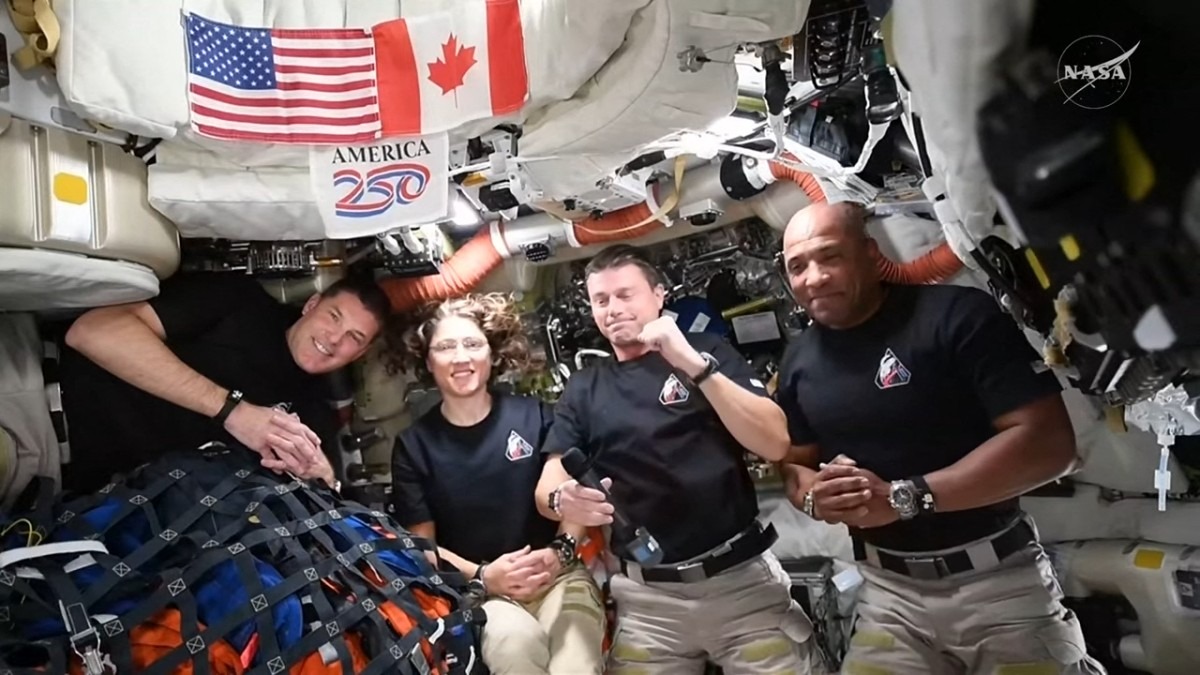
Four astronauts have safely returned to Earth following the completion of NASA’s Artemis II mission the first crewed lunar flyby in more than half a century marking a defining moment in the history of human space exploration and reigniting global excitement about humanity’s return to the Moon.
The Orion spacecraft carrying mission commander Reid Wiseman, alongside crewmates Christina Koch, Victor Glover, and Canadian astronaut Jeremy Hansen, splashed down without incident off the California coast late Friday, capping a journey that clocked in at nine days, one hour, 31 minutes and 35 seconds which NASA rounds up to a 10-day mission.
“What a journey,” said Wiseman following splashdown, reporting that all crewmembers were “stable” and “green.” By late Friday, helicopters had lifted all four astronauts to a recovery ship off the Pacific coast near San Diego, where they demonstrated they were capable of walking unassisted a reassuring sign after nearly ten days in deep space.
Also Read: Tinubu Inaugurates 60-Megawatt Gas Turbine Plants in Bayelsa, Commissions Bridge and Major Roads
NASA administrator Jared Isaacman declared it “a perfect mission,” adding that the agency was “back in the business of sending astronauts to the Moon.”
The mission was studded with historic firsts. The four astronauts became the first humans to travel the furthest distance from Earth, reaching 252,756 miles (approximately 406,771 kilometres) from the planet’s surface. Glover became the first person of colour to fly around the Moon, Koch the first woman, and Hansen the first non-American.
During the voyage, the crew photographed thousands of images of deep space and the lunar surface, witnessed a solar eclipse, and observed extraordinary meteorite strikes on the Moon. In an emotional moment broadcast live, the crew named a lunar crater “Carroll” in honour of the late wife of mission commander Wiseman.
The re-entry phase, which exposed the spacecraft to temperatures around half as hot as the surface of the Sun at speeds exceeding 30 times the speed of sound, tested the Orion capsule’s heat shield under real crewed conditions for the first time. Flight director Rick Henfling acknowledged the tension, saying anyone who lacked anxiety bringing the spacecraft home “probably didn’t have a pulse.” The re-entry, however, proved smooth.
US President Donald Trump hailed the mission as “spectacular,” saying he “could not be more proud” before turning his gaze further into space: “Next step, Mars!” he posted on social media.
Also Read: World Bank Raises Alarm: Nigeria’s Fiscal Squeeze Slashes Capital Spending by N1 Trillion in 2025
Astronomer Derek Buzasi of the University of Chicago described the mission as “an almost flawless success,” saying it gave him “fresh confidence” in NASA’s next steps toward a sustained lunar presence.
NASA is now targeting as early as 2028 to put boots on the lunar surface, though experts have expressed scepticism about whether the lunar landers being developed by SpaceX and Blue Origin will be ready in time. China, meanwhile, is pursuing its own crewed Moon landing target of 2030.
For now, the world is watching a new chapter of space history unfold one that began with a splashdown off San Diego, and aims to end with human footprints on the Moon once more.
Stay informed and ahead of the curve! Follow The National Concord Blog Newsletter for real-time updates, breaking news, and exclusive content. Don't miss a headline – join now below!