

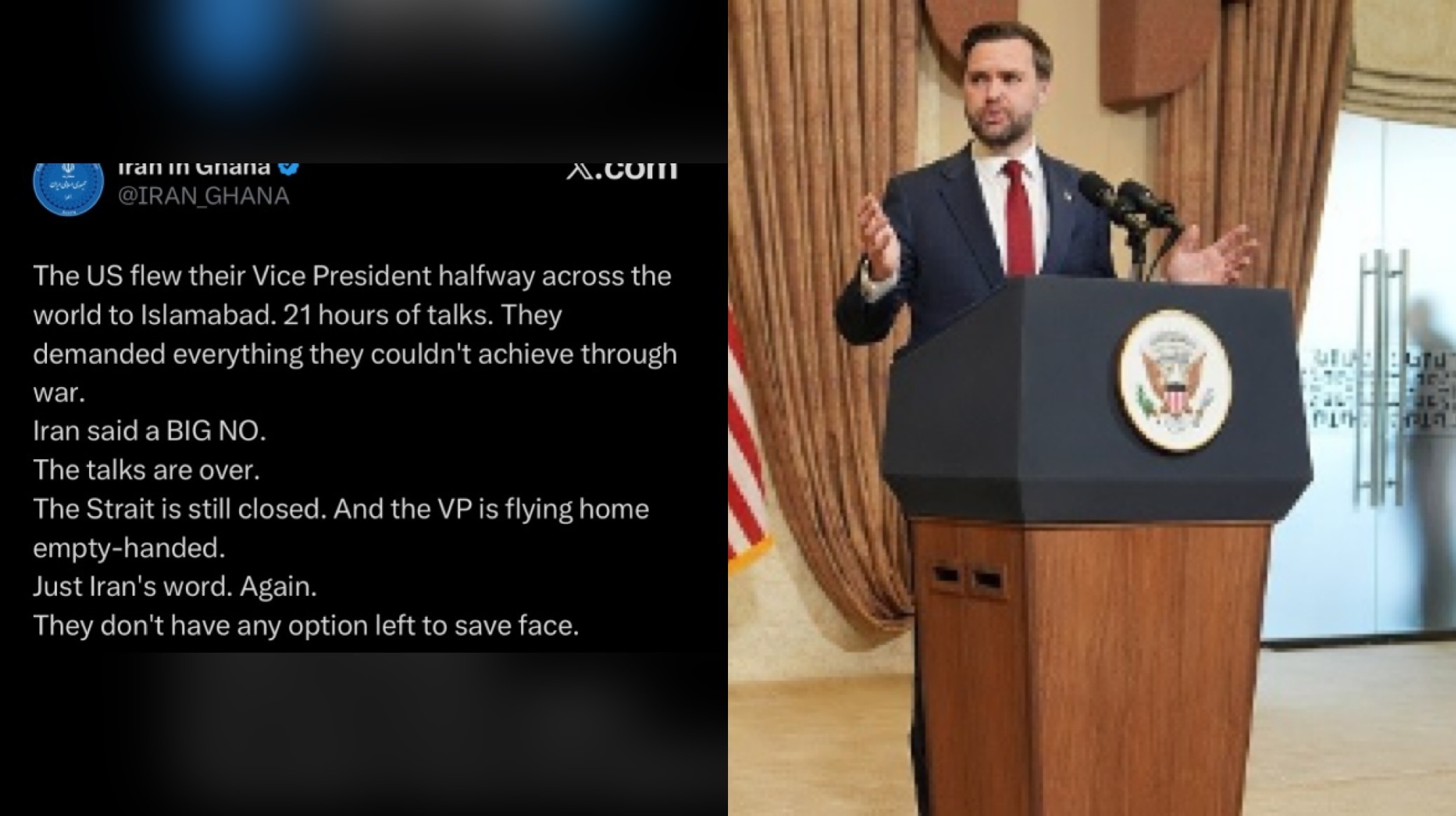
High-stakes diplomatic efforts to end the US-Iran war and reopen the Strait of Hormuz to global shipping have ended in failure, with United States Vice President JD Vance announcing on Sunday that 21 hours of face-to-face negotiations in Islamabad, Pakistan, produced no agreement leaving the world’s most critical oil chokepoint effectively closed and the prospect of renewed military escalation hanging in the air.
Vance, who led the American delegation alongside Special Envoy Steve Witkoff and presidential adviser Jared Kushner, held a brief press conference before boarding Air Force Two to return to Washington. “The bad news is that we have not reached an agreement. And I think that’s bad news for Iran much more than it’s bad news for the United States,” he told reporters, adding that Iran had “chosen not to accept our terms.”
The collapse of talks came after Iran rejected what Vance described as Washington’s “final and best offer,” with the core sticking point being Tehran’s refusal to make what the US considered a firm and long-term commitment to abandon the pursuit of nuclear weapons.
“The simple question is, do we see a fundamental commitment of will for the Iranians not to develop a nuclear weapon, not just now, not just two years from now, but for the long term? We haven’t seen that yet,” Vance said.
Also Read: ADC Crisis: David Mark, PRP Leaders Hold Closed-Door Talks as Opposition Alignments Deepen
Iran’s state media attributed the breakdown to what it described as “excessive demands” by the US negotiating team, particularly over control of the Strait of Hormuz and the removal of nuclear materials from Iranian territory. Tehran’s 10-point negotiating framework had included demands for the release of frozen Iranian assets, the lifting of all primary and secondary sanctions, continued Iranian sovereignty over the Strait of Hormuz, and an end to Israeli attacks on Lebanon conditions the United States rejected as a basis for agreement.
The crisis has its roots in events that began on 28 February 2026, when the United States and Israel launched an air war against Iran that killed Supreme Leader Ali Khamenei and destroyed significant Iranian military infrastructure. In retaliation, Iran closed the Strait of Hormuz through which approximately 20 per cent of the world’s crude oil and 20 per cent of global liquefied natural gas normally flow deploying sea mines and launching attacks on merchant shipping.
A fragile two-week ceasefire brokered by Pakistan had appeared to offer a pathway to de-escalation, but the strait remained effectively closed throughout, with Iran charging tolls of over $1 million per vessel for the few ships it permitted to pass. Iranian demands for transit fees of up to $2 million per vessel which could generate an estimated $100 billion annually for the Islamic Revolutionary Guard Corps drew fierce resistance from Washington.
As the Islamabad talks were underway, two US Navy guided-missile destroyers the USS Frank E. Peterson Jr. and the USS Michael Murphy transited the Strait of Hormuz as part of a mine-clearing operation, marking the first passage of American warships through the strait since the conflict began. The move was intended to signal Washington’s resolve to restore freedom of navigation, though Iranian forces issued warnings to vessels approaching without Tehran’s permission.
Also Read:2027: Mascot Uzor Kalu Fires Warning at Abia APC Leadership, Condemns Alleged Plot to Impose Governorship Candidate Through “Kangaroo Endorsement”
The immediate human cost of the failed negotiations was visible on tracking screens almost instantly. Two supertankers the Agios Fanourios I bound for Iraq and the Pakistan-flagged Shalamar headed for the UAE had begun approaching the strait but executed last-minute U-turns upon news of the talks breakdown, highlighting the extreme risk environment still facing global shipping.
Pakistan’s Foreign Minister Ishaq Dar, whose government hosted the negotiations and played a central mediation role, urged both parties to uphold the ceasefire despite the failure to reach a final agreement, characterising the 21-hour session as “intense and constructive” and calling on both sides to maintain the positive spirit of engagement.
With talks now collapsed, President Trump faces a stark choice resume military strikes to force the strait open by force, or continue pursuing diplomatic engagement while global oil markets remain in turmoil and energy prices continue to spike across the world, including in Nigeria where petrol costs have soared past ₦1,200 per litre partly as a consequence of the Middle East crisis.
Stay informed and ahead of the curve! Follow The National Concord Blog Newsletter for real-time updates, breaking news, and exclusive content. Don't miss a headline – join now below!