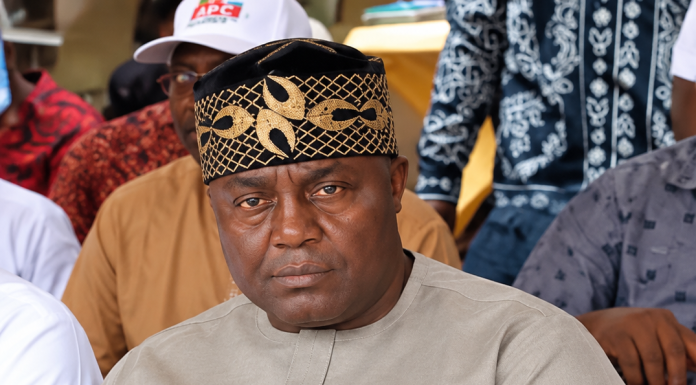


Politics in Nigeria has always been a contact sport. But what happened recently around the reported EFCC raid at the Umuahia residence of His Excellency, Distinguished Senator Theodore Ahamefula Orji, tells us we have crossed from politics into perfidy. The story claimed five billion dollars recovered, pre-written election results, exotic cars, and gold jewelry. It trended for hours.
Then came the quiet part. The same blogs that amplified the story began to retract.
“The information was false,” they said. No raid. No billions. No loot. Just a fabrication, carefully packaged and pushed out to stain a name and sway a conversation.
This is desperation taken too far. When politicians can no longer win arguments on policy, records, or service, they resort to manufacturing scandals.
The target this time is the Orji family, a name that carries weight in Abia politics. The method is old: throw enough mud and hope something sticks before the truth catches up.
The tragedy is not just that a lie was told. It is how fast the lie traveled, and how slow the correction moved. In the age of WhatsApp forwards and faceless blogs, a false headline can destroy a reputation before breakfast, while the retraction barely gets a glance at dinner.
That is why we must talk about journalism, not just politics. A democracy without credible information is a democracy running on fumes. The public relies on reporters and editors to separate fact from fiction, to verify before they vilify. When that gate collapses, everyone loses.
What we saw in the Orji case was not journalism. It was stenography for rumor. No EFCC statement was cited. No photographs were provided. No court documents were produced. Yet the figures were specific: five billion dollars.
The details were cinematic: pre-written results, exotic cars, gold jewelry. Specificity is the oldest trick of a lie trying to sound true.
This is where interpretative and investigative journalism must step in. Interpretative journalism asks “what does this mean, and who benefits?” Investigative journalism asks “where is the proof?” Both were missing. Instead, we got copy-and-paste outrage designed to trend, not to inform.
Real investigative work is slow, tedious, and expensive. It means calling the EFCC spokesperson. It means visiting Umuahia. It means checking property records and bank trails. It means waiting. But in a click-driven economy, waiting is treated as a weakness. So we publish first and verify later, if at all.
The cost of that shortcut is enormous. Senator Orji’s name was dragged through the mud for a story that did not exist. His family, his constituents, and the institution of the Senate were all dragged with him. Even after retractions, the stain lingers in screenshots and group chats. Digital ink does not wash off easily.
This should concern every professional journalist in Nigeria. The Nigeria Union of Journalists, the Nigerian Guild of Editors, and the Press Council must do the needful. The profession is being overrun by quacks, bloggers with no training, no ethics, and no accountability.
Being a journalist is not just owning a website and a data subscription. It comes with duties: verify, attribute, correct, and apologize when wrong. Professional bodies must set and enforce standards. They must sanction outlets that repeatedly publish fabrications, and they must create pathways for continuous training in fact-checking and investigative methods.
We also need media literacy for the public. Readers must learn to ask: who wrote this? What is the source? Was there a retraction? Until audiences punish fake news by ignoring it, purveyors will keep producing it.
To the politicians behind this stunt, a direct word: face issues. If you have a case against Senator Orji or anyone else, take it to the EFCC, the courts, or the ballot. Do not hide behind anonymous blogs and midnight press releases.
Falsehood and propaganda are infantile tools. They may give a 48-hour high, but they lead straight to ignominy. Voters are tired of drama. They want roads, jobs, schools, and security. Anyone who thinks Nigeria can be won with forged headlines is underestimating the people.
The desperation on display is also an admission. It tells us that some political actors have nothing to campaign on except the destruction of others. That is not strategy. That is surrender.
Senator Orji and his family deserve an apology, not just retractions. But more than that, Nigeria deserves a media ecosystem that treats truth as non-negotiable. A free press is not free to lie. Freedom comes with responsibility.
Let this Orji hoax be a turning point. Let newsrooms invest in investigation desks again. Let editors ask harder questions before they hit publish. Let professional bodies purge the union of quacks and defend those who do the hard work of truth-telling.
In the end, politics will pass, but the record remains. History will not remember the fake headline. It will remember who had the courage to correct it, and who chose to build instead of burn. Nigeria needs more builders.
Stay informed and ahead of the curve! Follow The National Concord Blog Newsletter for real-time updates, breaking news, and exclusive content. Don't miss a headline – join now below!