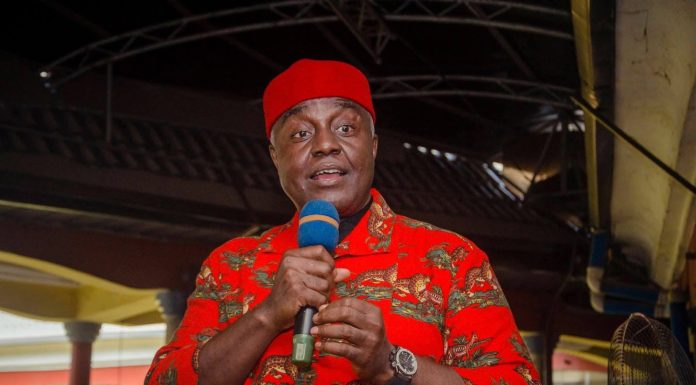



It is not every day that a serving government official, particularly in Nigeria’s political climate of scripted optimism, breaks down publicly emotional, shaken, and brutally honest. But when the Minister of Interior, Olubunmi Tunji-Ojo, recently almost shed tears while discussing Nigeria’s dire security state, it wasn’t just a breakdown, it was a warning siren. A reality check. A raw admission that Nigeria’s worsening insecurity is no longer something that can be swept under a red carpet of political promises.
In a widely circulated video, the Minister lamented the abysmal state of Nigeria’s border protection infrastructure.
“The capital budget for the Nigerian Immigration Service is less than ₦10 billion, yet we’re expected to protect over 4,000 kilometers of border. One terrorist is killed, and 20 more come in.”
he said.
He wasn’t exaggerating. He was grieving.
This confession comes at a time when the country is still reeling from yet another tragic attack in Benue State, where over 30 villagers were killed in Ado Local Government Area by armed men believed to be herdsmen militia. The attack, which occurred in the early hours of the morning, saw entire households wiped out and survivors fleeing into the bush. In the words of a local official, “What happened in Ado is not just an attack, it’s a massacre.”
Benue, often described as the food basket of the nation, has become a killing field. This latest attack is just one in a long series of violent episodes plaguing Nigeria’s Middle Belt where a dangerous cocktail of ethnic tension, religious divides, and climate-driven migration disputes have led to unchecked bloodshed.
Yet, while citizens mourn, Nigeria’s security infrastructure are underfunded and overburdened staggers on.
“We have some of the most brilliant minds in our DSS and NIA. The NSA is doing his best, but the fact that Nigerians only think of the military when they hear ‘security’ is itself a sign of systemic failure.”
he added.
It is a system that has reduced the police force to beggars of budgetary releases, stripped cybersecurity of strategic importance, and left rural communities to defend themselves with sticks against sophisticated weaponry. The Minister was not offering excuses, he was exposing a cancer.
“We are running cybersecurity on an ad hoc arrangement. We are 20 years behind.”
he said.
A Nation on the Brink
Nigeria’s security crisis is no longer confined to Boko Haram or the bandit-ravaged North West. It is now a national emergency:
- In the North Central, farmers and herders clash with frightening regularity, often with heavy civilian casualties
- In the North East, resurgent Boko Haram factions and Islamic State West Africa Province (ISWAP) cells continue to attack military outposts
- In the South East, separatist agitations have morphed into armed violence, targeting police and civilians alike
- In the North West, bandits control forests, kidnap at will, and extort communities with impunity
- And in the South West, increasing concerns around cult violence, kidnappings, and cybercrime fuel local unrest
The emotional testimony of Olubunmi Tunji-Ojo, though painful, echoes what many Nigerians have said for years we need to stop pretending. The country’s population over 240 million strong deserves more than speeches and sporadic interventions. It demands systemic reform, bold investments in internal security, and a modernized strategy that goes beyond military boots.
But perhaps the most haunting line from the Minister was not about funding or frameworks.
“Do we want a system that works, or do we just want to play to the gallery?”
he asked.
The Real Question for Nigeria
At the heart of Nigeria’s insecurity is a leadership test, one that no administration, past or present, has fully passed. From porous borders to under-equipped police forces, from ignored intelligence to unchecked rural massacres, the cracks have widened into canyons.
The attack in Benue is not an isolated incident. It is a symptom. The Minister’s tears? They are a verdict.
The government must now decide whether to heed that verdict and act, or to continue dressing wounds with speeches while the country bleeds.
Because while ministers may cry today, it is the people who continue to die every day.
Stay informed and ahead of the curve! Follow The National Concord Blog Newsletter for real-time updates, breaking news, and exclusive content. Don't miss a headline – join now below!