

Nigeria spent $1.19bn on food imports in the first six months of 2026, despite the Federal Government’s efforts to increase domestic agricultural production and reduce dependence on foreign food supplies.
The amount represents an increase of $121.52m, or 11.41 per cent, compared with the $1.07bn spent during the corresponding period of 2025.
The figures were contained in an analysis of the Central Bank of Nigeria’s Quarterly Statistical Bulletin for the second quarter of 2026, which showed sustained demand for foreign exchange to finance food imports.
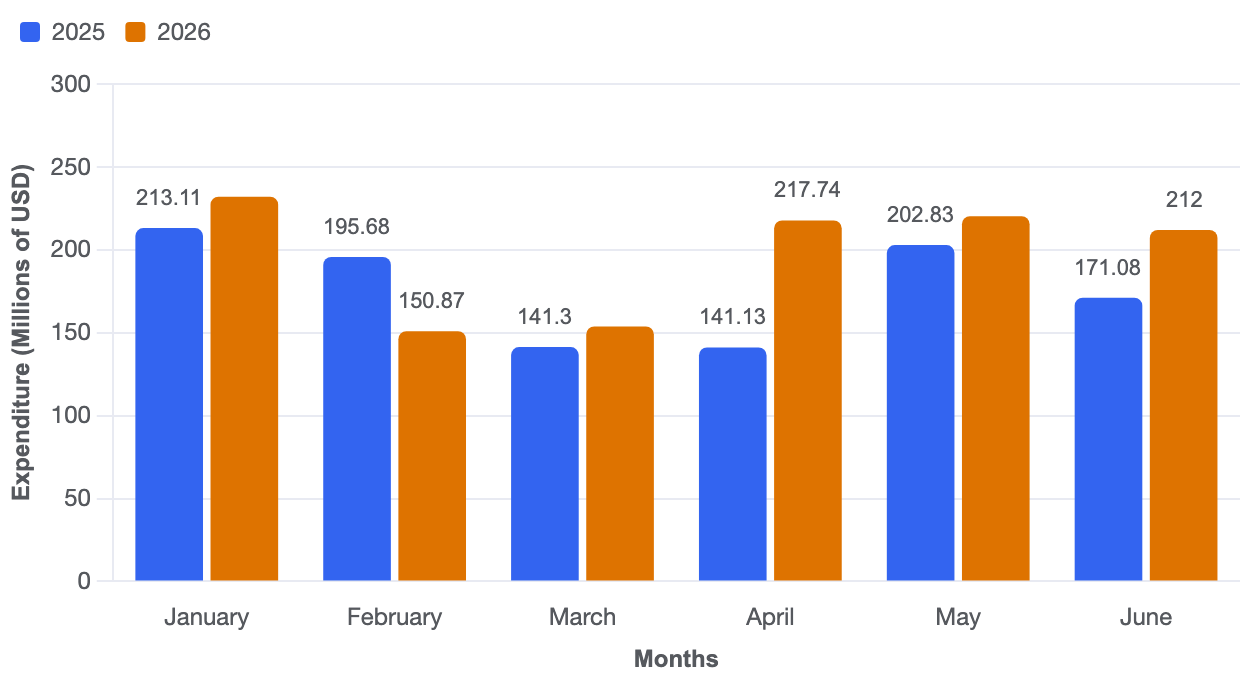
A breakdown of the data showed that Nigeria spent $232.05m on food imports in January 2026, compared with $213.11m in January 2025, representing an increase of 8.89 per cent.
However, spending declined by 22.90 per cent in February to $150.87m from $195.68m recorded in the corresponding month of the previous year.
In March, food import expenditure rose to $153.73m, compared with $141.30m in March 2025.
The sharpest increase occurred in April, when spending surged by 54.28 per cent to $217.74m from $141.13m a year earlier.
Foreign exchange utilisation for food imports also increased by 8.59 per cent in May to $220.26m, compared with $202.83m in the same month of 2025.
In June, the figure rose by 23.92 per cent to $212m from $171.08m recorded in June 2025.
Overall, food import-related foreign exchange spending increased in five of the six months under review, with February recording the only year-on-year decline.
On a quarterly basis, spending declined by 2.57 per cent in the first quarter of 2026 to $536.65m from $550.79m in the corresponding period of 2025.
The trend reversed in the second quarter, when expenditure increased by 26.38 per cent to $650m from $514.34m recorded a year earlier.
The second-quarter increase more than offset the decline in the first quarter, pushing total food import spending for the first half of the year above the previous year’s level.
The development comes as the Federal Government continues to pursue policies aimed at improving local food production, strengthening agricultural value chains and reducing reliance on imported commodities.
However, stakeholders have identified insecurity, inadequate mechanisation and low technology adoption as major challenges limiting domestic agricultural output.
The President of the Association of Small Business Owners of Nigeria, Femi Egbesola, attributed the country’s continued dependence on food imports partly to insecurity, which he said had forced some farmers to abandon their farmlands.
He also called for greater investment in agricultural technology and modern equipment to improve productivity, particularly among smallholder farmers.
Meanwhile, the Emir of Kano, Muhammadu Sanusi II, has warned that excessive reliance on imported food could undermine domestic agricultural businesses and threaten long-term food security.
Sanusi argued that while food imports could help ease prices in the short term, the government needed to support local farmers and processors to ensure sustainable food supply.
The latest figures highlight the challenge facing Nigeria as it seeks to balance food affordability with efforts to expand domestic production and conserve foreign exchange.
Stay informed and ahead of the curve! Follow The National Concord Blog Newsletter for real-time updates, breaking news, and exclusive content. Don't miss a headline – join now below!