

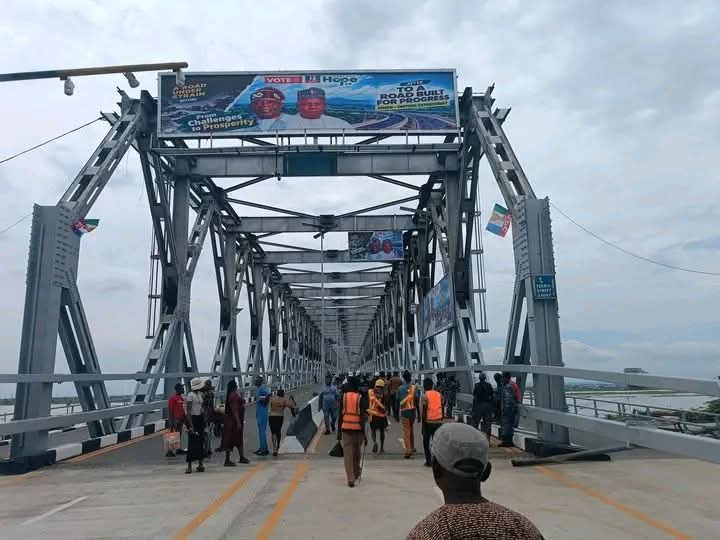
The Federal Government has reopened the First Niger Bridge linking Onitsha, Anambra State, to Asaba, Delta State, following about 38 days of closure for emergency rehabilitation and maintenance works.
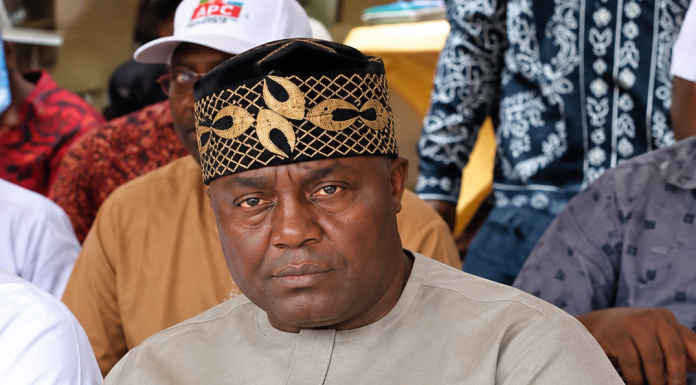
Minister of Works, Senator David Umahi, announced the reopening on Thursday, October 15, 2026, at a ceremony attended by government officials and traditional rulers from the two states.
The bridge was closed on September 7 after the discovery of damaged and vandalised structural components, including steelwork around its expansion joints. The closure, initially scheduled to end on September 21, was extended due to persistent rainfall and other delays.
Umahi said the rehabilitation was aimed at improving the structural condition of the bridge, enhancing road safety and ensuring smoother movement of people and goods between the South-East and South-South regions.
The intervention included structural repairs, road resurfacing, the installation of solar-powered streetlights and Closed-Circuit Television cameras, as well as additional traffic management measures.
The minister also disclosed that median barriers and three designated turnaround points had been provided to improve traffic control, particularly during emergencies and vehicle breakdowns.
He, however, acknowledged that some aspects of the rehabilitation work were yet to be completed.
FG Warns Against Activities Threatening Bridge Safety
Umahi raised concerns over activities capable of undermining the bridge’s structural integrity, particularly sand dredging around the facility.
He warned that federal regulations prohibit dredging within a 10-kilometre radius of federal bridges and directed relevant officials in Anambra and Delta states to enforce the restriction.
The minister also stressed the need to protect the ageing bridge against excessive loading, vandalism and poor maintenance, noting that sustained monitoring would be essential to preserving the structure.
The First Niger Bridge, completed in 1965, remains a critical transport corridor for commercial activities, passenger movement and the distribution of goods between the two regions.
Tinubu, State Governments Commended
The minister commended President Bola Tinubu for supporting the rehabilitation project, while also acknowledging the contributions of the governors of Anambra and Delta states and the contractor, SKCC.
Umahi urged residents of the South-East and South-South to support Tinubu’s re-election bid in 2027, citing the administration’s infrastructure projects in the regions.
Delta State Governor, Sheriff Oborevwori, represented at the ceremony by the Commissioner for Works (Rural Roads) and Public Information, Charles Aniagwu, also commended the Federal Government for responding to concerns over the bridge’s condition.
Oborevwori emphasised the importance of maintaining public infrastructure before deterioration becomes a major threat to public safety and economic activity.
He warned that any collapse of the bridge would have serious consequences for trade, transportation and the livelihoods of people across the South-East and South-South.
Similarly, the Asagba of Asaba, Professor Epiphany Azinge, SAN, described the rehabilitation as a significant intervention that would strengthen the bridge and extend its service life.
The traditional ruler noted that the bridge plays a vital role in the economic and social relationship between Anambra and Delta states, as well as the wider regions they connect.
FG Outlines Other Road Projects
Beyond the bridge rehabilitation, Umahi announced plans to redesign the Benin-Asaba Expressway ahead of reconstruction, citing concerns about its deteriorating condition.
He said the Federal Government had cancelled a remedial contract covering the first 11 kilometres of the highway over dissatisfaction with the quality of work.
The minister also disclosed plans to reconstruct approximately 400 kilometres of the East-West Road, describing the project as a spur of the 750-kilometre Lagos-Calabar Coastal Highway.
Other projects highlighted included sections of the Enugu-Onitsha Expressway and the Second Niger Bridge bypass.
Umahi said the 17.5-kilometre Second Niger Bridge bypass, valued at approximately ₦172 billion, was under construction.
He reaffirmed the Federal Government’s commitment to infrastructure development, noting that reliable road networks remain essential to economic growth, regional integration and national development.
The reopening of the First Niger Bridge is expected to restore normal movement along the strategic route after weeks of disruption, providing relief to commuters, transport operators and businesses that depend on the corridor.
Stay informed and ahead of the curve! Follow The National Concord Blog Newsletter for real-time updates, breaking news, and exclusive content. Don't miss a headline – join now below!