


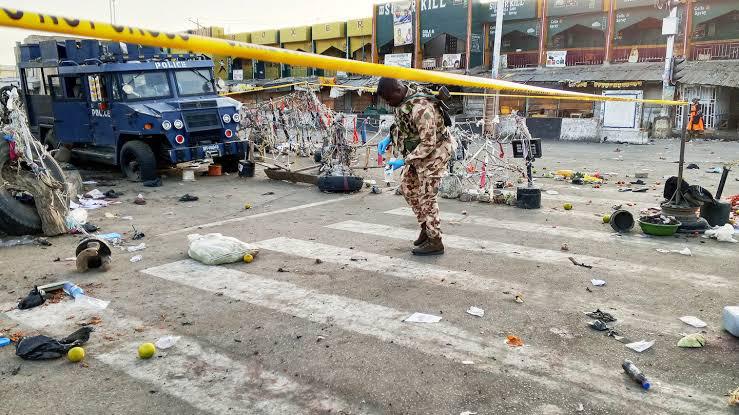
At least 131 casualties have been recorded following a series of coordinated suicide bomb attacks in Maiduguri, the capital of Borno State, in one of the deadliest incidents to hit the city in recent years.
Police authorities confirmed that 23 people were killed while 108 others sustained injuries, bringing the total number of casualties to 131. The attacks, believed to have been carried out by suspected suicide bombers, occurred at about 7:24 p.m. on Monday.
According to the Borno State Police Command, the explosions targeted multiple crowded locations, including the Monday Market, the Post Office Flyover, and the entrance of the University of Maiduguri Teaching Hospital (UMTH)—areas known for heavy civilian presence.
Preliminary investigations indicate that the attackers used improvised explosive devices (IEDs), a tactic commonly associated with insurgent groups operating in Nigeria’s North-East.
Emergency responders, including the National Emergency Management Agency (NEMA) and the Borno State Emergency Management Agency, swiftly evacuated victims to nearby medical facilities, where dozens are currently receiving treatment.
Security forces, comprising police tactical units, military personnel, and explosive ordnance experts, were immediately deployed to the affected areas. The locations have since been cordoned off, while clearance operations were conducted to prevent further attacks.
The Commissioner of Police, Naziru Abdulmajid, also visited the scenes for an on-the-spot assessment, assuring residents of intensified security measures across the city.
Although no group has officially claimed responsibility, security experts suspect the involvement of extremist groups such as Boko Haram or its splinter faction, ISWAP, both of which have a long history of suicide attacks in the region.
The latest incident marks a disturbing resurgence of violence in Maiduguri, which had experienced relative calm in recent years after prolonged military operations pushed insurgents to rural areas. Reports indicate that the attacks were carried out during the Ramadan period, a time when public gatherings are typically high.
Residents described scenes of chaos and panic, with many fleeing for safety as multiple explosions rocked different parts of the city.
Authorities say normalcy has gradually returned, but security has been significantly heightened across Maiduguri to forestall further incidents.
As investigations continue, the attack underscores the persistent security challenges in Nigeria’s North-East and raises renewed concerns about the capacity of insurgent groups to strike at the heart of major urban centres.
Stay informed and ahead of the curve! Follow The National Concord Blog Newsletter for real-time updates, breaking news, and exclusive content. Don't miss a headline – join now below!