

By Oswald
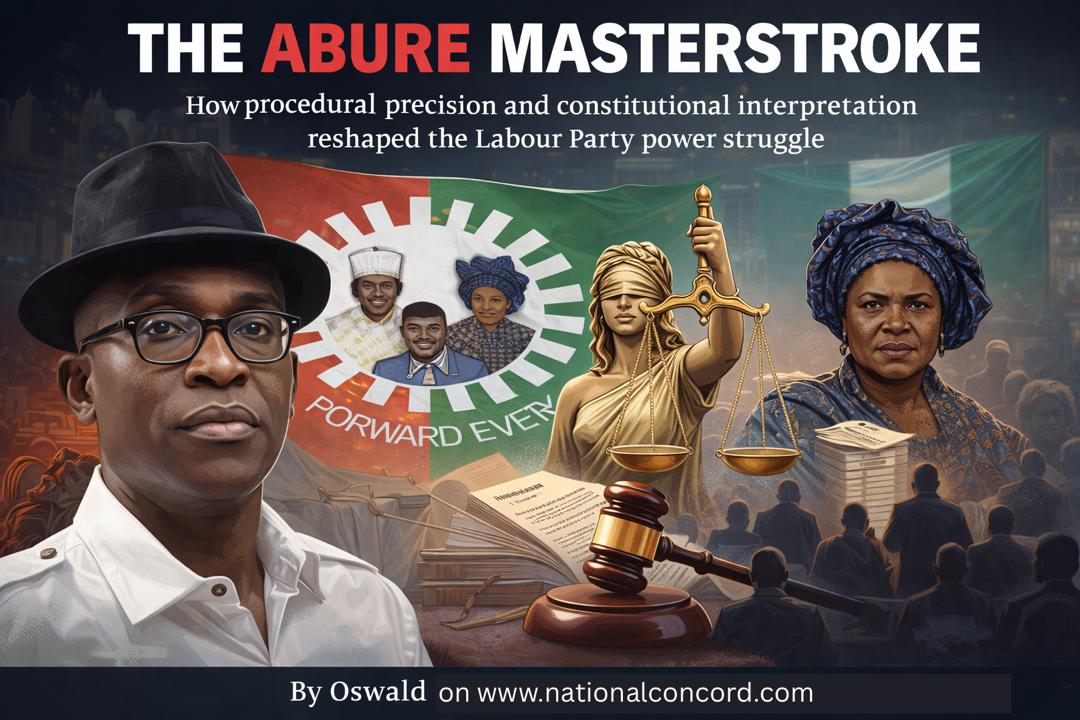
In what has evolved beyond a routine leadership dispute, the internal crisis within Nigeria’s Labour Party is increasingly being framed by observers as a complex contest of legal doctrine, institutional authority, and political survival.
According to Oswald, a political analyst closely following developments, the events of March 17, 2026, marked a turning point one that transformed the party’s internal wrangling into what he describes as a “masterclass in legal and procedural maneuvering.”
At the center of the unfolding drama is Labour Party National Chairman, Julius Abure, whose handling of the crisis has drawn both scrutiny and admiration. Oswald argues that Abure’s approach reflects a deep understanding of Nigeria’s political terrain, where, he says, “procedural accuracy often determines survival.”
A CALCULATED PARTY MOVE
On that date, the Labour Party’s National Executive Council (NEC) convened and announced the dissolution of the caretaker committee led by Nenadi Usman. While the decision may appear administrative on the surface, Oswald insists it was anything but.
He describes it as a “multi-layered institutional maneuver,” rooted in constitutional interpretation, legal doctrine, and strategic timing.
Central to the NEC’s argument is the Labour Party Constitution, which, according to party officials, does not recognize the position of a caretaker committee chairman. This omission, Oswald explains, forms the basis of the claim that the committee itself lacks constitutional legitimacy.
ALSO READ: ABIA LP ON THE BRINK: ACTING SECRETARY ACCUSED OF SABOTAGE AS INTERNAL WAR DEEPENS
“The implication,” he notes, “is that any structure not expressly provided for in the party’s constitution becomes, in legal terms, an anomaly.”
LAW, DOCTRINE, AND POLITICAL REALITY
Oswald points to established legal principles such as locus standi and exclusio unius est exclusio alterius the idea that the explicit mention of certain roles excludes others as underpinning the NEC’s position.
Within this framework, the Usman-led committee is portrayed by party actors as an “extra-constitutional construct,” lacking the legal standing required to exercise authority.
Yet, perhaps the most striking element of the NEC’s strategy, according to Oswald, lies in what he calls a “controlled recognition approach.”
By briefly acknowledging the existence of the caretaker committee particularly in light of an earlier court order delivered by Peter Lifu—the NEC, he argues, effectively assumed jurisdiction over the body, only to dissolve it thereafter.
“To the casual observer, this may seem contradictory,” Oswald explains. “But in legal strategy, it is a calculated repositioning of the battlefield from a constitutional debate to an internal disciplinary action.”
SHIFTING THE BATTLEGROUND
This shift, he adds, is critical. By framing the issue as an internal matter, the party may rely on protections afforded under Section 83(5) of the Electoral Act, which limits judicial interference in the internal affairs of political parties.
Oswald further references the precedent set in Onuoha v. Okafor, a landmark Supreme Court decision that reinforced the autonomy of political parties in managing their internal disputes.
“The NEC’s action appears designed to test and perhaps reinforce this long-standing judicial principle,” he says.
THE QUESTION OF PROCEDURE
Another contentious aspect of the March 17 meeting was the reported exclusion of Usman from the virtual NEC session. However, Oswald dismisses concerns over this, noting that the validity of such meetings depends on quorum rather than the presence of specific individuals.
Drawing parallels with the principle established in Foss v. Harbottle, he argues that the will of the majority ultimately prevails.
“With over 60 members present,” he notes, “the NEC not only met quorum requirements but also positioned itself to ratify its decisions if challenged.”
LOOKING AHEAD
As the matter potentially heads to the Court of Appeal, Oswald suggests that the outcome may already be taking shape within the party’s internal structures.
By the time proceedings commence in April, he argues, the political reality may have overtaken the legal contest.
In his assessment, the NEC’s actions have consolidated Abure’s position as national chairman, while significantly weakening the standing of the dissolved caretaker committee.
“The real question,” Oswald concludes, “is whether the courts will intervene or defer to the party’s assertion of internal sovereignty.”
For now, the Labour Party crisis stands as a vivid illustration of the intersection between law and politics in Nigeria a contest not just of power, but of interpretation, timing, and institutional control.
Stay informed and ahead of the curve! Follow The National Concord Blog Newsletter for real-time updates, breaking news, and exclusive content. Don't miss a headline – join now below!